
Why design permeability and let art do its strategic work?

Updated: Jan 20
In boardrooms and strategy decks, a new word is circulating with unusual persistence: permeability. It describes the quality of systems that allow ideas, perspectives, and practices to pass through without losing structure, yet without hardening into silos. Increasingly, this permeability between business and art is not a cultural nicety but a competitive advantage.
Permeable companies survive by letting art destabilize them before the market does. And yet, much of its potential remains untapped.
The reason is not lack of interest. It is habit. Decades of silo thinking, efficiency-only paradigms, and the relentless pursuit of fast, high-yield wins have trained organizations to optimize what already exists rather than question what could exist. In that logic, art is often tolerated as decoration, branding, or employee "wellbeing". Valuable, perhaps, but peripheral. This is where the real loss occurs.
Art does not operate at the level of outputs alone. Its true contribution is megacognitive (we invite you to feel kindly reminded of our thought every time you will hear this word again in the near future): it changes how we think before it changes what we do. Art interrogates assumptions, stretches perception, and rehearses alternative futures without immediately demanding closure. In a business context, this capacity is not ornamental, it is foundational to navigating complexity.
That is why the role of art in organizations (quite similar to branding & marketing by the way) cannot be confined to a department. It is better understood as a cross-departmental, outward-facing, and deeply integrative consulting function. It touches strategy, leadership, innovation, ethics, and culture simultaneously. It listens not only to markets, but to society, to cultural shifts, to ecological signals, to what is emerging but not yet legible in data.
Where traditional consulting often accelerates decision-making, art expands the decision space. Crucial! This expansion matters because disruption does not have to be violent. Art has a rare ability to turn the world upside down without breaking trust. Through narrative, symbolism, and embodied experience, it creates new vision while preserving dignity. People are more willing to contribute, support, and commit when they feel invited rather than overrun. In times of transformation and change, this is not soft power, it is stabilizing power.
However, permeability comes at a price. On the tag: art embraces ambiguity. It resists linearity. It asks questions that do not immediately justify themselves in spreadsheets. For organizations trained to equate control with safety, this can feel threatening. The task, then, is not to tame art but to create safe spaces around it: for not knowing, non-linear exploration, and hypotheses that challenge rigid systems rather than confirm them.
This does not mean abandoning performance or profit. It means understanding that sustainable performance depends on the ability to adapt, not just execute. Art trains this adaptive muscle and helps leaders rehearse uncertainty, sense weak signals, and make sounder decisions under incomplete information. Over time, it replaces frozen fear with practiced responsiveness.

So, where to begin? Start small, but start seriously. We are happy to help you onboard artists as thinking partner, not as entertainers. Position them close to leadership and strategy, frame their contribution as inquiry, not output. Ask questions such as: What are we not seeing? What stories are we telling ourselves? Where are we over-optimizing and under-imagining?
Equally important: protect time. Thinking requires duration. Insight does not thrive under constant urgency. Allow room for experiments that may fail and say so explicitly. Failure, when contained and reflected upon, it not waste but rehearsal.
Finally, model permission from the top. When leaders admit "we do not know", they do not weaken authority, they humanize it. They signal trust in collective intelligence and invite courage in others. In a world that rewards speed, choosing permeability is an act of bravery. It is a decision to invest in vision rather than only velocity, in ethics alongside efficiency, in adaptation over anxiety.
Our call to action: Have the courage to think. Make space for art as a catalyst and allow the unknown to work with you, not against.
The future will be won by those who can see differently, together. We hope to become part of the "together" that shapes what comes next.
Your truly,
Margot

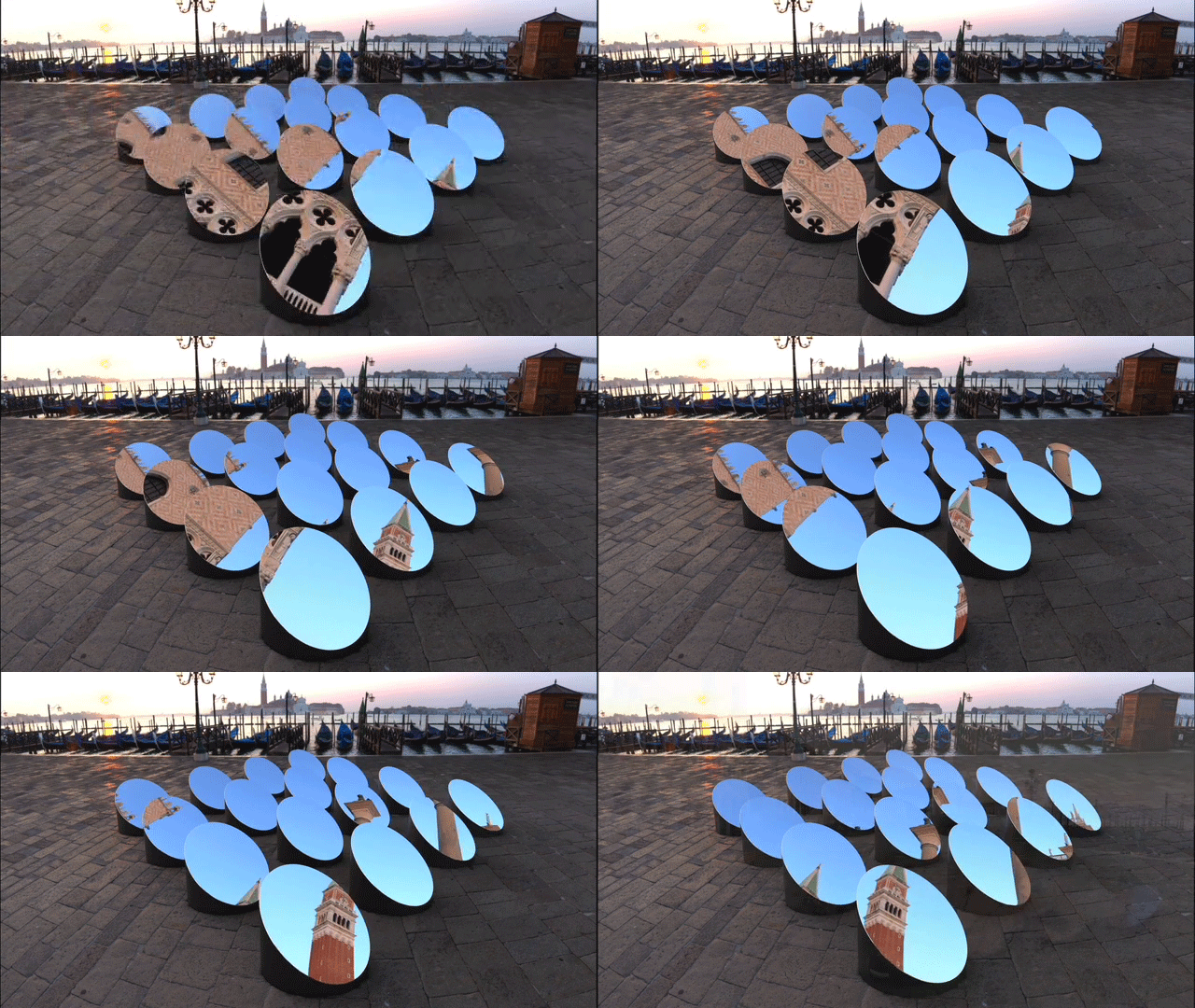
MD'A sidenote: Arnaud Lapierre (b. 1979) created the art installation AZIMUT that provided an alternative perspective of Venice. Composed of 16 moving mirrors, the temporary artwork was designed to sit in front of the exquisite Palazzo Ducale. As the mirrors slowly turned, architectural details were fragmented and magnified, offering a captivating view of the beautiful Gothic architecture. The artwork drew visitors' attention beyond the main sights to the city's finer details and lesser-seen places.


Comments